Wilderness-Based Therapy with At-Risk Youth: The Impact Upon Conflict Resolution, Communication and Community
DOI:
https://doi.org/10.52935/18.13518.01Keywords:
Wilderness therapy, Adventure therapy, Resiliency, At-risk youth, Positive youth developmentAbstract
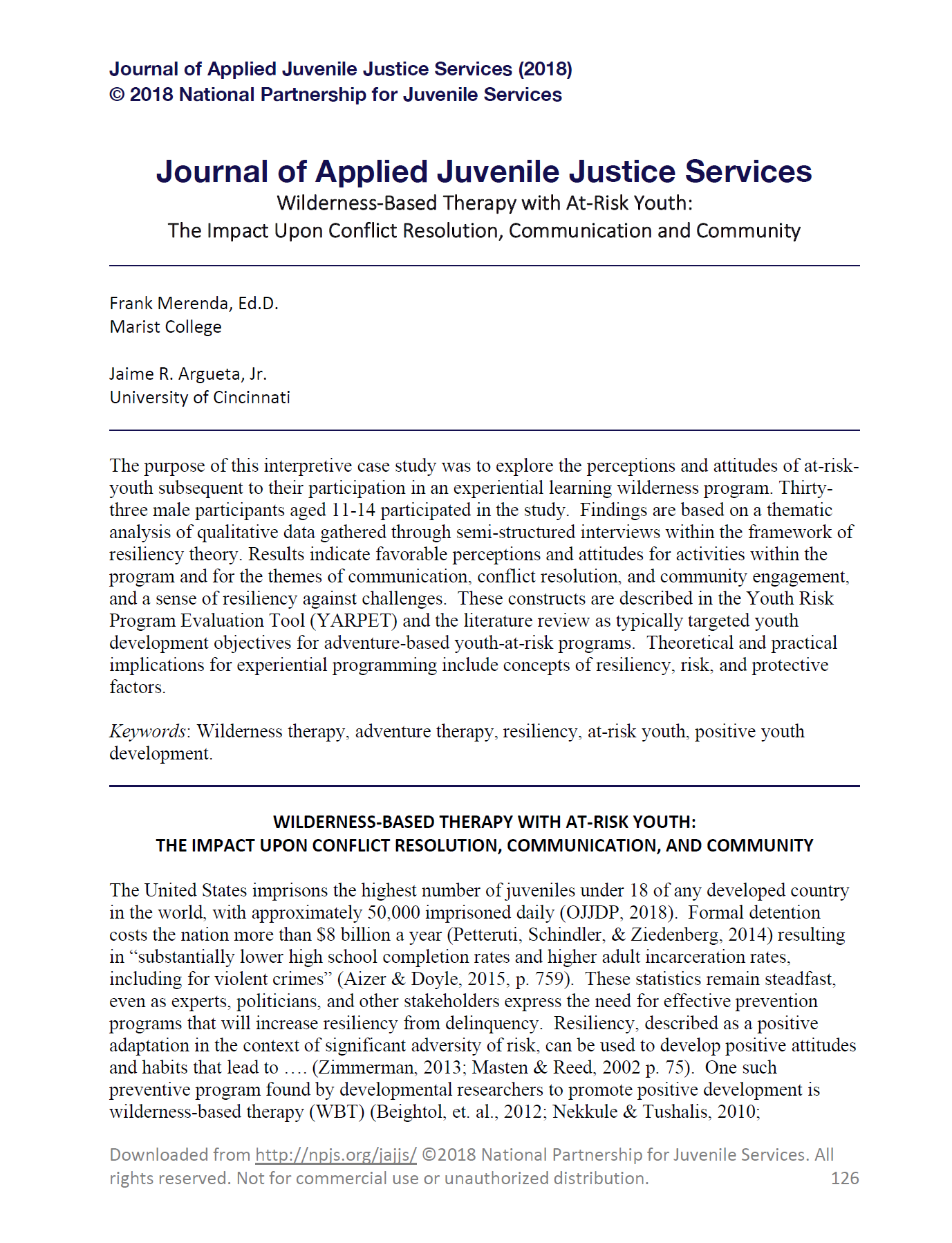
The purpose of this interpretive case study was to explore the perceptions and attitudes of at-risk youth subsequent to their participation in an experiential learning wilderness program. Thirtythree male participants aged 11-14 participated in the study. Findings are based on a thematic analysis of qualitative data gathered through semi-structured interviews within the framework of resiliency theory. Results indicate favorable perceptions and attitudes for activities within the program and for the themes of communication, conflict resolution, and community engagement, and a sense of resiliency against challenges. These constructs are described in the Youth Risk Program Evaluation Tool (YARPET) and the literature review as typically targeted youth development objectives for adventure-based youth-at-risk programs. Theoretical and practical implications for experiential programming include concepts of resiliency, risk, and protective factors.
References
Anna Aizer, Joseph J. Doyle; Juvenile Incarceration, Human Capital, and Future Crime: Evidence from Randomly-Assigned Judges, The Quarterly Journal of Economics, Volume 130, Issue 2, 1 May 2015, Pages 759–803
Armour, K., Sandford, R., & Duncombe, R. (2012). Positive youth development and physical activity/sport interventions: Mechanisms leading to sustained impact. Physical Education & Sport Pedagogy, (ahead-of-print), 1-26
Child Family Community Australia (Ed.). (2012). Australian Institute of Family Studies. Retrieved from https://aifs.gov.au/
Bandoroff, S. (1989). Wilderness-adventure therapy for delinquent and pre-delinquent youth: A review of the literature.
Bandura, A., & Walters, R. H. (1977). Social learning theory.
Beightol, J., Jevertson, J., Carter, S., Gray, S., & Gass, M. (2012). Adventure Education and Resilience Enhancement. Journal of Experiential Education, 35(2), 307-325. doi:10.1177/105382591203500203
Bonanno, G. A. (2004). Loss, trauma, and human resilience. American Psychologist, 59, 20-28
Booth, J.W. & Neill, J.T. Journal of Outdoor and Environmental Education (2017) 20: 47. https://doi.org/10.1007/BF03401002
Brooks, J. E. (2006). Strengthening resilience in children and youths: Maximizing opportunities through the schools. Children & Schools, 28(2), 69-76.
Bryman, A. (2012). Social research methods. Oxford University Press.
Cason, D., & Gillis, H. “. (1994). A meta-analysis of outdoor adventure programming with adolescents. Journal of Experiential Education, 17(1), 40-47.
Clem, J. M., Prost, S. G., & Thyer, B. A. (2015). Does wilderness therapy reduce recidivism in delinquent adolescents?: A narrative review. Journal of Adolescent and Family Health, 7(1), 2.
Cottle, C. C., Lee, R. J., & Heilbrun, K. (2001). The prediction of criminal recidivism in juveniles: A meta-analysis. Criminal Justice and Behavior, 28(3), 367-394.
Cotton, S., & Butselaar, F. (2013). Outdoor adventure camps for people with mental illness. Australasian Psychiatry, 21(4), 352-358. doi:10.1177/1039856213492351
Cullen, F. T., & Gendreau, P. (2000). Assessing correctional rehabilitation: Policy, practice, and prospects. Criminal Justice, 3(1), 299-370.
Day, D., Wanklyn, S., & Yessine, A. (2014). A review of terminological. Conceptual, and Methodological Issues in the Developmental Risk Factor Literature.
Development Services Group, Inc. 2015. “Protective Factors for Delinquency.” Literature review. Washington, D.C.: Office of Juvenile Justice and Delinquency Prevention.
Albanese, J. S. (1993). Dealing with delinquency: The future of juvenile justice Nelson-Hall Chicago.
Dishion, T. J., Veronneau, M., & Myers, M. W. (2010). Cascading peer dynamics underlying the progression from problem behavior to violence in early to late adolescence. Development and Psychopathology, 22(3), 603-619.
Eccles, J. S. (1999). The development of children ages 6 to 14. The Future of Children, 30-44.
Eccles, J. S., & Barber, B. L. (1999). Student council, volunteering, basketball, or marching band: What kind of extracurricular involvement matters? Journal of Adolescent Research, 14(1), 10-43.
Eckert, P. (1989). Jocks and burnouts: Social categories and identity in the high school Teachers College Press.
Ewert, A., & Yoshino, A. (2011). The influence of short-term adventure-based experiences on levels of resilience. Journal of Adventure Education & Outdoor Learning, 11(1), 35-50. doi:10.1080/14729679.2010.532986
Ewert, A. W., McCormick, B. P., & Voight, A. E. (2001). Outdoor experiential therapies: Implications for TR practice. Therapeutic Recreation Journal, 35(2), 107.
Farrington, D. P. (1986). Age and crime. Crime and Justice, 7, 189-250.
Farrington, D. P., Loeber, R., & Ttofi, M. M. (2012). Risk and protective factors for offending. The Oxford Handbook of Crime Prevention, 46-69.
Fergus, S., & Zimmerman, M. A. (2005). Adolescent resilience: A framework for understanding healthy development in the face of risk. Annu.Rev.Public Health, 26, 399-419.
Fleming, C. B., Catalano, R. F., Haggerty, K. P., & Abbott, R. D. (2010). Relationships between level and change in family, school, and peer factors during two periods of adolescence and problem behavior at age 19. Journal of Youth and Adolescence, 39(6), 670-682. doi:10.1007/s10964-010-9526-5
Gass, M. A., Gillis, H. L., & Russell, K. C. (2012). Adventure therapy: Theory, research, and practice Routledge.
Gillis, H. L., Speelman, E., Linville, N., Bailey, E., Kalle, A., Oglesbee, N., Jensen, J. (2016). Meta-analysis of treatment outcomes measured by the Y-OQ and Y-OQ-SR comparing wilderness and non-wilderness treatment programs. Paper presented at the Child & Youth Care Forum, 45(6) 851-863.
Greene, R. R., Conrad, A. P., Livingstone, N. C., Barton, W. H., Watkins, M. L., Blundo, R., Riley, J. G. (2002). An integrated approach to practice, policy, and research. Washington, DC: National Association of Social Workers Press.
Hattie, J., Marsh, H. W., Neill, J. T., & Richards, G. E. (1997). Adventure education and outward bound: Out-of-class experiences that make a lasting difference. Review of Educational Research, 67(1), 43-87.
Henderson, N., Milstein, M. M. (1996). Management of organizational behavior: Utilizing human resources (5th ed.). Thousand Oaks, CA: Corwin Press.
Jessor, R. (1991). Risk behavior in adolescence: A psychosocial framework for understanding and action. Journal of Adolescent Health
Jones, C. D., Lowe, L. A., & Risler, E. A. (2004). The effectiveness of wilderness adventure therapy programs for young people involved in the juvenile justice system. Residential Treatment for Children & Youth, 22(2), 53-67.
Jozefowicz-Simbeni, D. M., & Allen-Meares, P. (2002). Poverty and schools: Intervention and resource building through school-linked services. Children & Schools, 24(2), 123-136.
Katz, C. M., & Fox, A. M. (2010). Risk and protective factors associated with gang-involved youth in Trinidad and Tobago. Revista Panamericana De Salud Publica, 27(3), 187-202.
Leschied, A., Chiodo, D., Nowicki, E., & Rodger, S. (2008). Childhood predictors of adult criminality: A meta-analysis drawn from the prospective longitudinal literature. Canadian Journal of Criminology and Criminal Justice, 50(4), 435-467.
Lipsey, M. W. (2009). The primary factors that characterize effective interventions with juvenile offenders: A meta-analytic overview. Victims and Offenders, 4(2), 124-147.
Lipsey, M. W., & Wilson, D. (2000). Practical meta-analysis (applied social research methods).
Loeber, R. (1990). Development and risk factors of juvenile antisocial behavior and delinquency. Clinical Psychology Review, 10(1), 1-41.
Loeber, R., Burke, J. D., & Pardini, D. A. (2009). Development and etiology of disruptive and delinquent behavior. Annual Review of Clinical Psychology, 5, 291-310.
Loeber, R., & Farrington, D. P. (2012). From juvenile delinquency to adult crime: Criminal careers, justice policy, and prevention Oxford University Press.
Loeber, R., & Farrington, D. P. (2014). Age-crime curve. Encyclopedia of criminology and criminal justice (pp. 12-18) Springer.
Loeber, R., Farrington, D. P., Stouthamer-Loeber, M., & Van Kammen, W. B. (1998). Antisocial behavior and mental health problems: Explanatory factors in childhood and adolescence Psychology Press.
Loeber, R., & Wikstrom, P. H. (1993). Individual pathways to crime in different types of neighborhoods. Integrating Individual and Ecological Aspects of Crime, 169-204.
Lubans, D. R., Plotnikoff, R. C., & Lubans, N. J. (2012). Review: A systematic review of the impact of physical activity programmes on social and emotional well-being in at-risk youth.
Child and Adolescent Mental Health, 17(1), 2–13. doi:10.1111/j.1475-3588.2011.00623.x
Margalit, D., Ben-Ari, A., (2014). The effect of wilderness therapy on adolescents’ cognitive autonomy and self-efficacy: Results of a non-randomized trial. Child Youth Care Forum, 43(2), 181-194.
Masten, A. S.& Reed, M. G. (2002) Resilience in Development. C.R. Snyder S.J. Lopez (Ed.), The Handbook of Positive Psychology. New York: Oxford University Press, s.143.
Miller, Holly Ventura, Wesley G. Jennings, Lorna L. Alvarez-Rivera, and Lonn Lanza-Kaduce. 2009. “Self-Control, Attachment, and Deviance among Hispanic Adolescents.” Journal of Criminal Justice 37: 77–84.
Minor, K. I., Wells, J. B., & Angel, E. (2008). Recidivism among juvenile offenders following release from residential placements: Multivariate predictors and gender differences. Journal of Offender Rehabilitation, 46(3-4), 171-188.
Najaka, S. S., Gottfredson, D. C., & Wilson, D. B. (2001). A meta-analytic inquiry into the relationship between selected risk factors and problem behavior. Prevention Science, 2(4), 257-271.
Nation, M., Crusto, C., Wandersman, A., Kumpfer, K. L., Seybolt, D., Morrissey-Kane, E., & Davino, K. (2003). What works in prevention: Principles of effective prevention programs. American Psychologist, 58(6-7), 449.
Neill, J. T., Marsh, H. W., & Richards, G. E. (2003a). The life effectiveness questionnaire: Development and psychometrics. Unpublished Manuscript, University of Western Sydney, Sydney, NSW, Australia,
Neill, J. T., Marsh, H. W., & Richards, G. E. (2003b). The life effectiveness questionnaire: Development and psychometrics. Unpublished Manuscript, University of Western Sydney, Sydney, NSW, Australia,
Noakes, M. A., & Rinaldi, C. M. (2006). Age and gender differences in peer conflict. Journal of Youth and Adolescence, 35(6), 881-891.
O’Brien, K., Daffern, M., Chu, C. M., & Thomas, S. D. (2013). Youth gang affiliation, violence, and criminal activities: A review of motivational, risk, and protective factors. Aggression and Violent Behavior, 18(4), 417-425.
OJJDP Statistical Briefing Book. Online. Available: https://www.ojjdp.gov/ojstatbb/corrections/qa08201.asp?qaDate=2016. Released on March 27, 2018.
O'Leary, V. E. (1998). Strength in the face of adversity: Individual and social thriving. Journal of Social Issues, 54, 425-446.
Peck, S. C., Davis-Kean, P. E., Schnabel, К, Malanchuk, О, & Eccles, J. S. (1999). (1999). Self esteem does matter: Research on the longitudinal impact of self-esteem. Paper presented at the Poster Presented at the American Psychological Society Conference, Denver, CO.
Petteruti, A., Schindler, M., & Ziedenberg, J. (2014). Sticker shock: Calculating the full price tag for youth incarceration Justice Policy Institute.
Protective factors against delinquency. (2015, December). Retrieved November 10, 2017, from https://www.ojjdp.gov/mpg/litreviews/Protective%20Factors.pdf
Richman, J. M., & Fraser, M. W. (2001). Resilience in childhood: The role of risk and protection. The Context of Youth Violence: Resilience, Risk, and Protection, 1-12.
Rose, A. J., & Asher, S. R. (1999). Children's goals and strategies in response to conflicts within a friendship. Developmental Psychology, 35(1), 69.
Russell, K. (2003). An assessment of outcomes in outdoor behavioral healthcare treatment. Child and Youth Care Forum, 32(6), 355-381. doi:CCAR.0000004507.12946.7e
Russell, K. C. (2006). Brat camp, boot camp, or……..? exploring wilderness therapy program theory. Journal of Adventure Education & Outdoor Learning, 6(1), 51-67.
Rutter, M. (1987). Psychosocial resilience and protective mechanisms. American Journal of Orthopsychiatry, 57, 316-331. Google Scholar, Crossref, Medline, ISI
Saldaña, J., & Omasta, M. (2017). Qualitative research: Analyzing life. Los Angeles: SAGE.
Shaw, C.R., & McKay, H. D. (1942). Juvenile delinquency and urban areas. Chicago, Ill.
Sickmund, M., Sladky, A., & Kang, W. (2017). Easy access to juvenile court statistics: 1985-2013. National Center for Juvenile Justice.Available at: Http://Www.Ojjdp.Gov/Ojstatbb/Ezajcs/Asp/Selection.Asp.Accessed June
Stouthamer-Loeber, M., Loeber, R., Wei, E., Farrington, D. P., & Wikstrom, P. H. (2002). Risk and promotive effects in the explanation of persistent serious delinquency in boys. Journal of Consulting and Clinical Psychology, 70(1), 111.
Sullivan, C. J., & Latessa, E. (2011). The coproduction of outcomes: An integrated assessment of youth and program effects on recidivism. Youth Violence and Juvenile Justice, 9(3), 191-206.
Tanner-Smith, E. E., Wilson, S. J., & Lipsey, M. W. (2013). The comparative effectiveness of outpatient treatment for adolescent substance abuse: A meta-analysis. Journal of Substance Abuse Treatment, 44(2), 145-158.
Tekin, A. (2010). Wildlife recreation: Utilizing wilderness adventure therapy to prevent delinquency in minors. Journal of Human Sciences, 7(2), 640-654.
Thurber, C. A., Scanlin, M. M., Scheuler, L., & Henderson, K. A. (2007). Youth development outcomes of the camp experience: Evidence for multidimensional growth. Journal of Youth and Adolescence, 36(3), 241-254.
Walsh, M. A. (2009). Wilderness adventure programming as an intervention for youthful offenders: Self-efficacy, resilience, and hope for the future University of Minnesota.
Wang, M. C., Haertel, G. D., & Walberg, H. J. (1998). Models of reform: A comparative guide. Educational Leadership, 55(7), 66-71.
West, S. T., & Crompton, J. L. (2001). A review of the impact of adventure programs on at-risk youth. Journal of Park & Recreation Administration, 19(2)
Whittington, Anja, Aspelmeier, Jeffery E., & Budbill, Nadine W. (2016) Promoting resiliency in adolescent girls through adventure programming, Journal of Adventure Education and Outdoor Learning, 16:1, 2-15, DOI: 10.1080/14729679.2015.1047872
Zimmerman, M.A. (2013). Resiliency theory: A strengths-based approach to research and practice for adolescent health. Health Education & Behavior, 40(4), 381-383. doi: 10:1177/1090198113493782
Downloads
Published
Issue
Section
License
Copyright (c) 2018 Journal of Applied Juvenile Justice Services

This work is licensed under a Creative Commons Attribution-NonCommercial-NoDerivatives 4.0 International License.