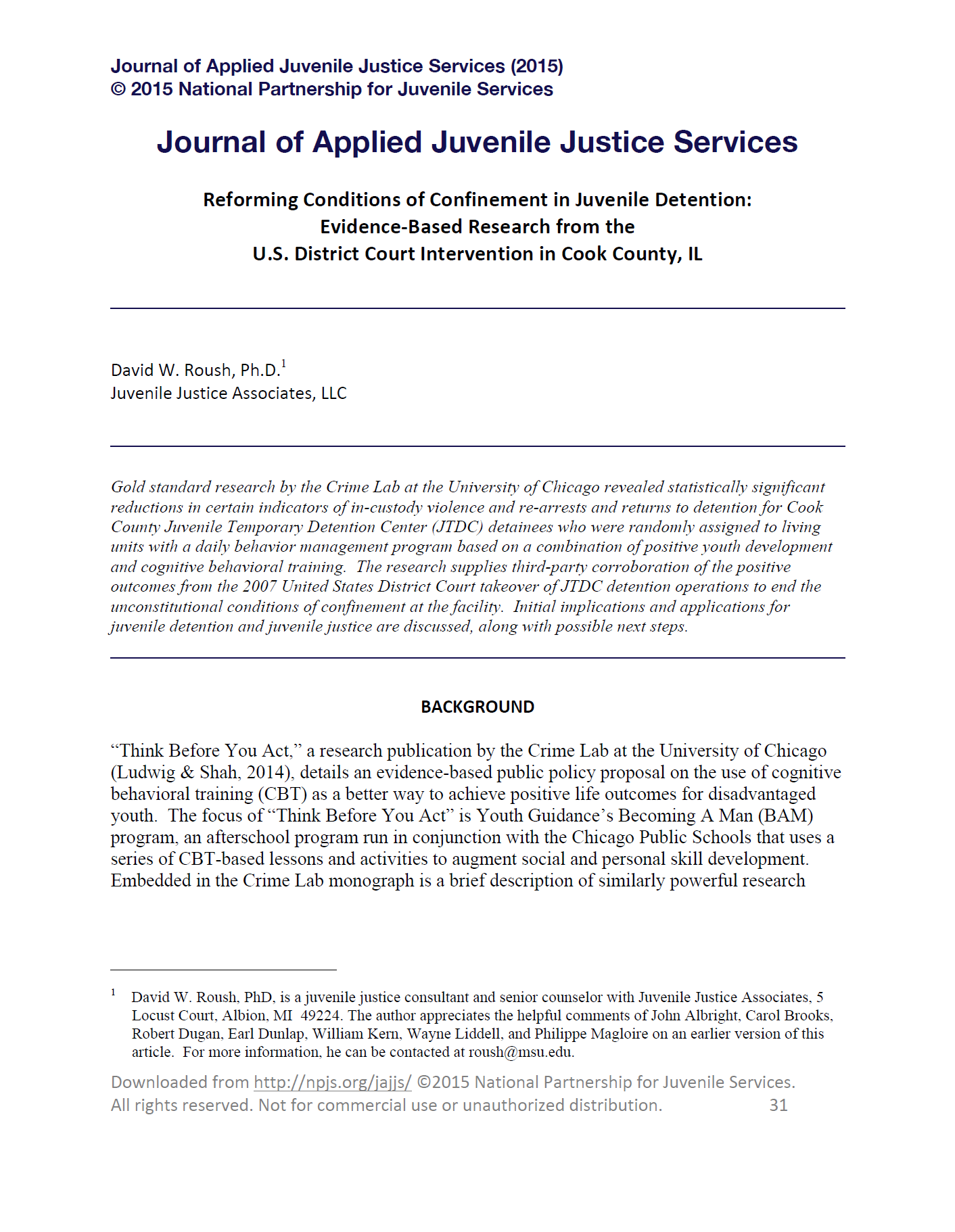
Reforming Conditions of Confinement in Juvenile Detention: Evidence-‐Based Research from the U.S. District Court Intervention in Cook County, IL
DOI:
https://doi.org/10.52935/Abstract
Gold standard research by the Crime Lab at the University of Chicago revealed statistically significant reductions in certain indicators of in-custody violence and re-arrests and returns to detention for Cook County Juvenile Temporary Detention Center (JTDC) detainees who were randomly assigned to living units with a daily behavior management program based on a combination of positive youth development and cognitive behavioral training. The research supplies third-party corroboration of the positive outcomes from the 2007 United States District Court takeover of JTDC detention operations to end the
unconstitutional conditions of confinement at the facility. Initial implications and applications for juvenile detention and juvenile justice are discussed, along with possible next steps.
References
Barton, W. H., & Mackin, J R. (2012). Towards a strength-based juvenile correctional facility: Sustainability and effects of an institutional transformation. Journal of Offender Rehabilitation, 51:7, 435-452.
Barton, W. H., Mackin, J. R., & Fields, J. (2008). Assessing youth strengths in a residential juvenile correctional program. Residential Treatment for Children & Youth, 23 (3/4), 11–36.
Brendtro, L. K., Mitchell, M., & McCall, H. (2009). Deep brain learning: Pathways to potential with challenging youth. Albion, MI: Circle of Courage and Starr Commonwealth.
Brooks, C. C. & Roush, D. W. (2014, Spring). Transformation in the justice system. Reclaiming Children and Youth, 23 (1), 42-46.
Busch, D. (1999). By the numbers: The role of data and information in detention reform (Pathways Series #7). Baltimore, MD: Juvenile Detention Alternatives Initiative, Annie E. Casey Foundation.
Butts, J., Mayer, S., & Ruth, G. (2005). Focusing juvenile justice on Positive Youth Development. Chicago: Chapin Hall, University of Chicago.
Dahl, R. E. (2001). Affect regulation, brain development, and behavioral/emotional health in adolescence. CNS Spectrums, 6, 60-72.
Drake, E. K., Aos, S., & Miller, M. G. (2009). Evidence-based public policy options to reduce crime and criminal justice costs: Implications in Washington state. Victims & Offenders, 4 (2), 170-196.
Erwin, R. (2014). Adolescent Development (Chapter 6). In Desktop Guide to Quality Practice for Working with Youth in Confinement. Lexington, KY: National Partnership for Juvenile Services and Office of Juvenile Justice and Delinquency Prevention. Downloaded: http://www.desktopguide.info/?q=node/10.
Howell, J. C., Lipsey, M. W., Wilson, J. Q., & Howell, M. Q. (2014). A practical approach to evidence-based juvenile justice systems. Journal of Applied Juvenile Justice Services, 1, 1-21. Downloaded from http://npjs.org/jajjs/, © National Partnership for Juvenile Services.
Kahneman, D. (2011). Thinking, fast and slow. New York: Farrar, Straus and Giroux. Ludwig, J., & Shah, A. (2014, May). Think before you act: A new approach to preventing youth violence and dropout. Washington, DC: The Hamilton Project, Brookings Institute.
Roush, D. W. (1999). Helpful juvenile detention. Reaching Today’s Youth, 3, 63-68.
Roush, D. W. (2004). Juvenile detention in the 21st Century (Chapter 10). In A. R. Roberts (Ed.), Juvenile justice sourcebook (pp. 217-246). New York: Oxford Press.
Ryan, L., & Schindler, M. (2012). Notorious to notable: The crucial role of the philanthropic community in transforming the juvenile justice system in Washington, DC. Downloaded: http://mpdc.dc.gov/sites/default/files/dc/sites/dyrs/publication/attachments/Notorious%20to%20Notable.pdf.
Steinberg, L. (2014). Age of opportunity: Lessons from the new science of adolescence. Boston: Houghton Mifflin Harcourt.
Weick, K. E. (1984, January). Small wins: Redefining the scale of social problems. American Psychologist, 39, 40-49.
Downloads
Published
Issue
Section
License
Copyright (c) 2015 Journal of Applied Juvenile Justice Services

This work is licensed under a Creative Commons Attribution-NonCommercial-NoDerivatives 4.0 International License.