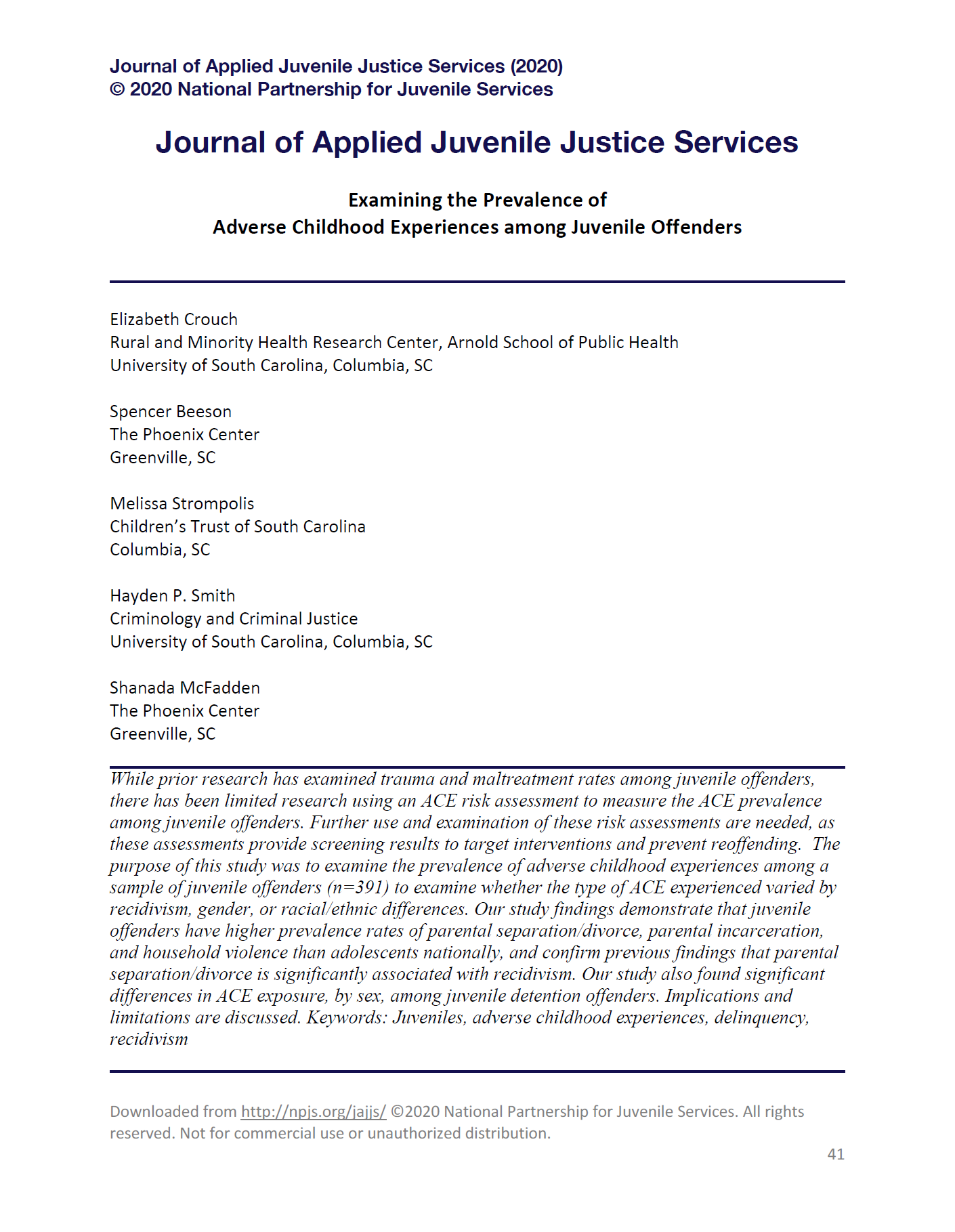
Examining the Prevalence of Adverse Childhood Experiences among Juvenile Offenders
DOI:
https://doi.org/10.52935/Keywords:
Juveniles, Adverse childhood experiences, Delinquency, RecidivismAbstract
While prior research has examined trauma and maltreatment rates among juvenile offenders, there has been limited research using an ACE risk assessment to measure the ACE prevalence among juvenile offenders. Further use and examination of these risk assessments are needed, as these assessments provide screening results to target interventions and prevent reoffending. The purpose of this study was to examine the prevalence of adverse childhood experiences among a sample of juvenile offenders (n=391) to examine whether the type of ACE experienced varied by recidivism, gender, or racial/ethnic differences. Our study findings demonstrate that juvenile offenders have higher prevalence rates of parental separation/divorce, parental incarceration, and household violence than adolescents nationally, and confirm previous findings that parental separation/divorce is significantly associated with recidivism. Our study also found significant differences in ACE exposure, by sex, among juvenile detention offenders. Implications and limitations are discussed.
References
AAP Council on Community Pediatrics. (2016). Poverty and child health in the United States Pediatrics, 137(4), e20160339. doi:10.1542/peds.2016-0339
Abram, K. M., Teplin, L. A., Charles, D. R., Longworth, S. L., McClelland, G. M., & Dulcan, M. K. (2004). Posttraumatic stress disorder and trauma in youth in juvenile detention. Archives of General Psychiatry, 61(4), 403-410.
Amato, P. R. (2001). Children of divorce in the 1990s: an update of the Amato and Keith (1991) meta-analysis. Journal of Family Psychology, 15(3), 355.
Anda, R. F., Felitti, V. J., Bremner, J. D., Walker, J. D., Whitfield, C. H., Perry, B. D., ... & Giles, W. H. (2006). The enduring effects of abuse and related adverse experiences in childhood: A convergence of evidence from neurobiology and epidemiology. European Archives of Psychiatry and Clinical Neuroscience, 256(3), 174–186. https://doi.org/10.1007/s00406-005-0624-4
Anda, R. F., Brown, D. W., Dube, S. R., Bremner, J. D., Felitti, V. J., & Giles, W. H. (2008). Adverse childhood experiences and chronic obstructive pulmonary disease in adults. American Journal of Preventive Medicine, 34(5), 396–403.
Ascend. (2019). What is 2Gen? Retrieved from the Aspen Institute website: https://ascend.aspeninstitute.org/two-generation/what-is-2gen/
Baglivio, M. T., Epps, N., Swartz, K., Huq, M. S., Sheer, A., & Hardt, N. S. (2014). The prevalence of adverse childhood experiences (ACE) in the lives of juvenile offenders. Journal of Juvenile Justice, 3(2), 1–23. Retreived from https://www.ncjrs.gov/pdffiles/246951.pdf
Baglivio, M. T., Wolff, K. T., Piquero, A. R., & Epps, N. (2015). The relationship between adverse childhood experiences (ACE) and juvenile offending trajectories in a juvenile offender sample. Journal of Criminal Justice, 43(3), 229–241.
Bogin J. (2006). Enhancing developmental services in primary care: The Help Me Grow experience. Journal of Developmental & Behavioral Pediatrics, 27(1), S8–S12.
Brown, D. W., Anda, R. F., Felitti, V. J., Edwards, V. J., Malarcher, A. M., Croft, J. B., & Giles, W. H. (2010). Adverse childhood experiences are associated with the risk of lung cancer: A prospective cohort study. BMC Public Health, 10(1), 20. https://doi.org/10.1186/1471-
2458-10-20
Brown, D. W., Anda, R. F., Tiemeier, H., Felitti, V. J., Edwards, V. J., Croft, J. B., & Giles, W. H. (2009). Adverse childhood experiences and the risk of premature mortality. American Journal of Preventive Medicine, 37(5), 389–396. https://doi.org/10.1016/j.amepre.2009.06.021
Brown, M. J., Masho, S. W., Perera, R. A., Mezuk, B., Pugsley, R. A., & Cohen, S. A. (2017). Sex disparities in adverse childhood experiences and HIV/STIs: mediation of psychopathology and sexual behaviors. AIDS and Behavior, 21(6), 1550–1566.
https://doi.org/10.1007/s10461-016-1553-0
Brown, M. J., Perera, R. A., Masho, S. W., Mezuk, B., & Cohen, S. A. (2015). Adverse childhood experiences and intimate partner aggression in the US: Sex differences and similarities in psychosocial mediation. Social Science & Medicine, 131, 48–57. https://doi.org/10.1016/j.socscimed.2015.02.044
Brown, M. J., Thacker, L. R., & Cohen, S. A. (2013). Association between adverse childhood experiences and diagnosis of cancer. PloS One, 8(6), e65524. https://doi.org/10.1371/journal.pone.0065524
Burt, S. A., Barnes, A. R., McGue, M., & Iacono, W. G. (2008). Parental divorce and adolescent delinquency: Ruling out the impact of common genes. Developmental Psychology, 44(6), 1668–1677.
Cannon, E. A., Anderson, M. L., Rivara, F. P., & Thompson, R. S. (2010). Adult health and relationship outcomes among women with abuse experiences during childhood. Violence and Victims, 25(3), 291–305. doi:10.1891/0886-6708.25.3.291
Cauffman, E., Feldman, S., Watherman, J., & Steiner, H. (1998). Posttraumatic stress disorder among female juvenile offenders. Journal of the American Academy of Child & Adolescent Psychiatry, 37(11), 1209–1216.
Chafouleas, S. M., Johnson, A. H., Overstreet, S., & Santos, N. M. (2016). Toward a blueprint for trauma-informed service delivery in schools. School Mental Health, 8(1), 144–162. https://doi.org/10.1007/s12310-015-9166-8
Chapman, D. P., Liu, Y., Presley-Cantrell, L. R., Edwards, V. J., Wheaton, A. G., Perry, G. S., & Croft, J. B. (2013). Adverse childhood experiences and frequent insufficient sleep in 5 US States, 2009: A retrospective cohort study. BMC Public Health, 13(1), 3. https://doi.org/10.1186/1471-2458-13-3
Chapman, D. P., Wheaton, A. G., Anda, R. F., Croft, J. B., Edwards, V. J., Liu, Y., ... & Perry, G. S. (2011). Adverse childhood experiences and sleep disturbances in adults. Sleep Medicine, 12(8), 773–779. https://doi.org/10.1016/j.sleep.2011.03.013
Chapman, D. P., Whitfield, C. L., Felitti, V. J., Dube, S. R., Edwards, V. J., & Anda, R. F. (2004). Adverse childhood experiences and the risk of depressive disorders in adulthood. Journal of Affective Disorders, 82(2), 217–225. https://doi.org/10.1016/j.jad.2003.12.013
Crouch, E., Probst, J., Radcliff, E., Bennett, K., & Hunt-McKinney, T. (in press). Prevalence of Adverse Childhood Experiences in a national sample. Child Abuse & Neglect.
Crouch, E., Radcliff, E., Strompolis, M., & Wilson, A. (2018a). Adverse childhood experiences (ACEs) and alcohol abuse among South Carolina adults. Substance Use & Misuse, 53(7), 1212–1220. https://doi.org/10.1080/10826084.2017.1400568
Crouch, E., Radcliff, E., Strompolis, M., & Wilson, A. (2018b). Examining the association between adverse childhood experiences and smoking-exacerbated illnesses. Public Health, 157, 62–68. https://doi.org/10.1016/j.puhe.2018.01.021
Crouch, E., Strompolis, M., Bennett, K. J., Morse, M., & Radcliff, E. (2017). Assessing the interrelatedness of multiple types of adverse childhood experiences and odds for poor health in South Carolina adults. Child Abuse & Neglect, 65, 204–211. https://doi.org/10.1016/j.chiabu.2017.02.007
Danese, A., Moffitt, T. E., Harrington, H., Milne, B. J., Polanczyk, G., Pariante, C. M., ... & Caspi, A. (2009). Adverse childhood experiences and adult risk factors for age-related disease: depression, inflammation, and clustering of metabolic risk markers. Archives of
Pediatrics & Adolescent Medicine, 163(12), 1135–1143. doi:10.1001/archpediatrics.2009.214
Dierkhising, C. B., Ko, S. J., Woods-Jaeger, B., Briggs, E. C., Lee, R., & Pynoos, R. S. (2013). Trauma histories among justice-involved youth: Findings from the National Child Traumatic Stress Network. European Journal of Psychotraumatology, 4(1), 20274. https://doi.org/10.3402/ejpt.v4i0.20274
D’Onofrio, B. M., Turkheimer, E., Emery, R. E., Slutske, W. S., Heath, A. C., Madden, P. A., & Martin, N. G. (2005). A genetically informed study of marital instability and its association with offspring psychopathology. Journal of Abnormal Psychology, 114(4), 570–586. http://dx.doi.org/10.1037/0021-843X.114.4.570
Dong, M., Anda, R. F., Felitti, V. J., Dube, S. R., Williamson, D. F., Thompson, T. J., ... & Giles, W. H. (2004). The interrelatedness of multiple forms of childhood abuse, neglect, and household dysfunction. Child Abuse & Neglect, 28(7), 771–784 https://doi.org/10.1016/j.chiabu.2004.01.008
Dowd, M. D., Forkey, H., Gillespie, R. J., Pettersen, T., Spector, L., & Stirling, J. (2014). Trauma Toolbox for Primary Care. Retrieved from the American Academy of Pediatrics website: http://www.aap.org/traumaguide
Evans, S. E., Davies, C., & DiLillo, D. (2008). Exposure to domestic violence: A meta-analysis of child and adolescent outcomes. Aggression and Violent Behavior, 13(2), 131–140.
Felitti, V. J., Anda, R. F., Nordenberg, D., Williamson, D. F., Spitz, A. M., Edwards, V., & Marks, J. S. (1998). Relationship of childhood abuse and household dysfunction to many of the leading causes of death in adults: The Adverse Childhood Experiences (ACE) Study. American Journal of Preventive Medicine, 14(4), 245–258. https://doi.org/10.1016/S0749-3797(98)00017-8
Ford, E. S., Anda, R. F., Edwards, V. J., Perry, G. S., Zhao, G., Li, C., & Croft, J. B. (2011). Adverse childhood experiences and smoking status in five states. Preventive Medicine, 53(3), 188–193. https://doi.org/10.1016/j.ypmed.2011.06.015
Ford, J. D., Chapman, J. F., Hawke, J., & Albert, D. (2007). Trauma among youth in the juvenile justice system: Critical issues and new directions. National Center for Mental Health and Juvenile Justice, 1–8.
Fox, B. H., Perez, N., Cass, E., Baglivio, M. T., & Epps, N. (2015). Trauma changes everything: Examining the relationship between adverse childhood experiences and serious, violent and chronic juvenile offenders. Child Abuse & Neglect, 46, 163–173.
Fraser, J. G., Griffin, J. L., Barto, B. L., Lo, C., Wenz-Gross, M., Spinazzola, J., ... & Bartlett, J. D. (2014). Implementation of a workforce initiative to build trauma-informed child welfare practice and services: Findings from the Massachusetts Child Trauma Project. Children and Youth Services Review, 44, 233–242. https://doi.org/10.1016/j.childyouth.2014.06.016
Garner, A. S., Shonkoff, J. P., Siegel, B. S., Dobbins, M. I., Earls, M. F., McGuinn, L., ... & Committee on Early Childhood, Adoption, and Dependent Care. (2012). Early childhood adversity, toxic stress, and the role of the pediatrician: translating developmental science
into lifelong health. Pediatrics, 129(1), e224–e231. doi:10.1542/peds.2011-2662
Ghandour, R. M., Perry, D. F., Kogan, M. D., & Strickland, B. B. (2011). The medical home as a mediator of the relation between mental health symptoms and family burden among children with special health care needs. Academic Pediatrics, 11(2), 161-169. https://doi.org/10.1016/j.acap.2010.12.015
Geller, A., Garfinkel, I., Cooper, C. E., & Mincy, R. B. (2009). Parental incarceration and child well-being: implications for urban families. Social Science Quarterly, 90(5), 1186–1202.
Grevstad, J. A. (2010, June). Adverse childhood experiences and juvenile justice. PowerPoint presentation to the Washington State Family Policy Council.
Griffin, G., Germain, E. J., & Wilkerson, R. G. (2012). Using a trauma-informed approach in juvenile justice institutions. Journal of Child & Adolescent Trauma, 5(3), 271–283.
Herrera, V. M., & McCloskey, L. A. (2001). Gender differences in the risk for delinquency among youth exposed to family violence. Child Abuse & Neglect, 25(8), 1037–1051.
Horwitz, A. V., Widom, C. S., McLaughlin, J., & White, H. R. (2001). The impact of childhood abuse and neglect on adult mental health: A prospective study. Journal of Health and Social Behavior, 42, 184–201. doi:10.2307/3090177
Kids Count Data Center. (2017). Teens age 16-19 not attending school and not working in South Carolina [Data set]. Retrieved from https://datacenter.kidscount.org
Kerker, B. D., Storfer-Isser, A., Szilagyi, M., Stein, R. E., Garner, A. S., O'Connor, K. G., ... & Horwitz, S. M. (2016). Do pediatricians ask about adverse childhood experiences in pediatric primary care? Academic Pediatrics, 16(2), 154–160. https://doi.org/10.1016/j.acap.2015.08.002
Larkin, H., Shields, J. J., & Anda, R. F. (2012). The health and social consequences of Adverse Childhood Experiences (ACE) across the lifespan: An introduction to prevention and intervention in the community. Journal of Prevention & Intervention in the Community,
40(4), 263–270. https://doi.org/10.1080/10852352.2012.707439
Letourneau, N., Dewey, D., Kaplan, B. J., Ntanda, H., Novick, J., Thomas, J. C., ... & APrON Study Team. (2019). Intergenerational transmission of adverse childhood experiences via maternal depression and anxiety and moderation by child sex. Journal of Developmental Origins of Health and Disease, 10, 1–12. https://doi.org/10.1017/S2040174418000648
Johnson, S. B., Riley, A. W., Granger, D. A., & Riis, J. (2013). The science of early life toxic stress for pediatric practice and advocacy. Pediatrics, 131, 319–327. doi:10.1542/peds.2012-0469
Metzler, M., Merrick, M. T., Klevens, J., Ports, K. A., & Ford, D. C. (2017). Adverse childhood experiences and life opportunities: Shifting the narrative. Children and Youth Services Review, 72, 141–9. https://doi.org/10.1016/j.childyouth.2016.10.021
Moylan, C. A., Herrenkohl, T. I., Sousa, C., Tajima, E. A., Herrenkohl, R. C., & Russo, M. J. (2010). The effects of child abuse and exposure to domestic violence on adolescent internalizing and externalizing behavior problems. Journal of Family Violence, 25(1), 53–63.
Murray, J., & Farrington, D. P. (2005). Parental imprisonment: Effects on boys’ antisocial behaviour and delinquency through the life-course. Journal of Child Psychology and Psychiatry, 46(12), 1269–1278.
Murray, J., & Farrington, D. P. (2008). Parental imprisonment: Long-lasting effects on boys' internalizing problems through the life course. Development and Psychopathology, 20(1), 273–290.
National Association of School Psychologists. (2016). Trauma-sensitive schools. Brief tips and policy recommendations. Retrieved from https:// www.nasponline.org/resources-andpublications/resources/mental-health/ trauma-sensitive-schools.
Parke, R., & Clarke-Stewart, K. A. (2002, January). Effects of parental incarceration on young children. Paper presented at the “From Prison to Home: The Effect of Incarceration and Reentry on Children, Families, and Communities” conference, U.S. Department of
Health and Human Services, Washington, DC. Retrieved from https://aspe.hhs.gov/basicreport/effects-parental-incarceration-young-children
Rolfsnes, E. S., & Idsoe, T. (2011). School-based intervention programs for PTSD symptoms: A review and meta-analysis. Journal of Traumatic Stress, 24(2):155–165. https://doi.org/10.1002/jts.20622
Shonkoff, J. P. (2016). Capitalizing on advances in science to reduce the health consequences of early childhood adversity. JAMA Pediatrics, 170(10), 1003–1007. doi:10.1001/jamapediatrics.2016.1559
Shonkoff, J. P., Boyce, W. T., & McEwen, B. S. (2009). Neuroscience, molecular biology, and the childhood roots of health disparities: Building a new framework for health promotion and disease prevention. JAMA, 301 (21), 2252–2259
Shonkoff, J. P., Garner, A. S., Siegel, B. S., Dobbins, M. I., Earls, M. F., McGuinn, L., ... & Committee on Early Childhood, Adoption, and Dependent Care. (2012). The lifelong effects of early childhood adversity and toxic stress. Pediatrics, 129(1), e232-e246. https://doi.org/10.1542/peds.2011-2663.
Silverstein, M., Grossman, D. C., Koepsell, T. D., & Rivara, F. P. (2003). Pediatricians’ reported practices regarding early education and Head Start referral. Pediatrics, 111(6), 1351–1357. doi:10.1542/peds.111.6.1351
Strompolis, M., Tucker, W., Crouch, E., & Radcliff, E. (2019). The intersectionality of adverse childhood experiences, race/ethnicity, and income: Implications for policy. Journal of Prevention & Intervention in the Community. Advance online publication. doi:10.1080/10852352.2019.1617387
Teague, R., Mazerolle, P., Legosz, M., & Sanderson, J. (2008). Linking childhood exposure to physical abuse and adult offending: Examining mediating factors and gendered relationships. Justice Quarterly, 25(2), 313–348.
Vos, T., Carter, R., Barendregt, J., Mihalopoulos, C., Veerman, L., Magnus, A., ... & Wallace, A. (2010). Assessing cost-effectiveness in prevention: ACE–prevention final report (September 2010). Retrieved from from Deakin Research Online: http://hdl.handle.net/10536/DRO/DU:30030306
Downloads
Published
Issue
Section
License
Copyright (c) 2020 Journal of Applied Juvenile Justice Services

This work is licensed under a Creative Commons Attribution-NonCommercial-NoDerivatives 4.0 International License.