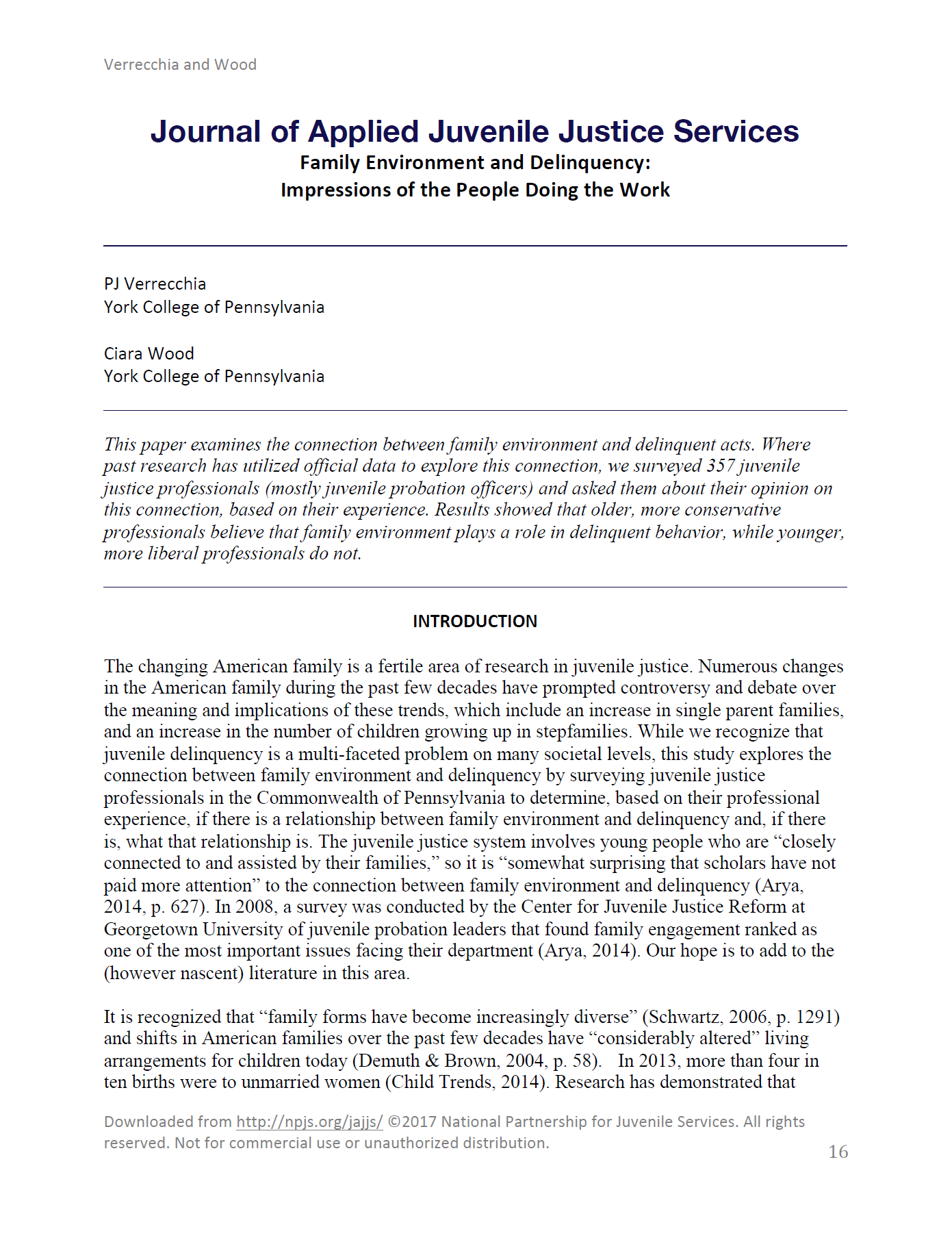
Family Environment and Delinquency: Impressions of the People Doing the Work
DOI:
https://doi.org/10.52935/Abstract
This paper examines the connection between family environment and delinquent acts. Where past research has utilized official data to explore this connection, we surveyed 357 juvenile justice professionals (mostly juvenile probation officers) and asked them about their opinion on this connection, based on their experience. Results showed that older, more conservative professionals believe that family environment plays a role in delinquent behavior, while younger, more liberal professionals do not.
References
Aquilino, W.S. (1996). The life course of children born to unmarried mothers: Childhood living arrangements and young adult outcomes. Journal of Marriage and The Family, 58(2), 293-310.
Arya, N. (2014). Family-driven justice. Arizona Law Review, 56(3), 623-706. Boyer, T.W. (2006). The development of risk-taking: A multi-perspective review. Developmental Review, 26, 291-345.
Burt, C. (1925). The Young Delinquents. London: University of London Press. Carlson, M. & Corcoran, M. (2001). Family structure and children’s behavioral and cognitive outcomes. Journal of Marriage and the Family, 63(3), 779-792.
Carlson, M., McLanahan, S. & England, PO. (2004). Union formation in fragile families. Demography, 412(2), 237-261.
Child Trends (2014). Births to unmarried women. Indicators on Children and Youth. Retrieved from http://www.childtrends.org/?indicators=births-to-unmarried-women on September 19, 2014.
Coley, R.L. & Medeiros, B.L. (2007). Reciprocal longitudinal relations between nonresident father involvement and adolescent delinquency. Child Development, 78(1), 132-147.
Crouter, A.C. & Head, M.R. (2002). Parental monitoring and knowledge of children. In M.H. Bornstein (Ed.), Handbook of Parenting (2nd ed.), pp. 461-482. Mahwah, NJ: Erlbaum.
Demo, D. & Cox, M. (2000). Families with young children: A review of research in the 1990s. Journal of Marriage and the Family, 62(4), 876-895.
Demuth, S. & Brown, S. L. (2004). Family structure processes, and adolescent delinquency: The significance of parental absence versus parental gender. Journal of Research in Crime and Delinquency (41), 1, 58-81.
Dishion, T.J., Nelson, S.E. & Kavanagh, K. (2003). The Family Check-Up for high risk adolescents: Preventing early-onset substance use by parent monitoring. Behavior Therapy, 34, 553-571.
Han, W., Miller, D.P. & Waldfogel, J. (2010). Parental work schedule and adolescent risky behaviors. Developmental Psychology (46), 5, 1245-1267.
Haveman, R., Wolfe, B. & Pierce, K. (2001). Intergenerational effects of nonmarital and early childbearing. In L.L. Wu & B. Wolfe (Eds.), Out of wedlock: Causes and consequences of nonmarital fertility. New York: Russell Sage Foundation.
Kennedy, S. & Bumpass, L. (2008). Cohabitation and children’s living arrangements: New estimations from the United States. Demographic Research, 19(47), 1663-1692.
Martinez, G.M., Daniels, K. & Chandra, A. (2012). Fertility of men and women aged 15-44 years in the United States: National survey of family growth, 2006-2010. National Health Statistics Reports, 51. Hyattsville, MD: National Center for Health Statistics. Table 12.
Maxfield, M.G. & Babbie, E. (2014). Research Methods for Criminal Justice and Criminology (7th Edition). Independence, KY: Cengage Learning
McLanahan, S. & Sandefur, G. (1994). Growing up With a Single Parent: What Hurts, What Helps? Cambridge, MA: Harvard University Press.
Musick, K. (2002). Planned and unplanned childbearing among unmarried women. Journal of Marriage and the Family, 64(4), 915-929.
Nye, F. I. (1958). Family Relationships and Delinquent Behavior. New York: John Wiley and Sons.
Pennington, L. (2012). Engaging parents as a legitimacy-building approach in juvenile delinquency court. UC Davis Journal of Juvenile Law and Policy, 16(2), 483-533.
Quensel, S., McArdle, P., Brinkley, A., & Wiegersma, A. (2002). Broken home or drug using peers: "Significant relations"? The Journal of Drug Issues, 32(2), 467-489.
Sander, J.B., Sharkey, J.D., Olivarri, R., Tanigawa, D.A. & Mauseth, T. (2010). A qualitative study of juvenile offenders, student engagement, and interpersonal relationships: Implications for research directions and preventionist approaches. Journal of Educational
and Psychological Consultation, 20, 288-315.
Schroeder, R., Osgood, A., & Oghia, M. (2010). Family transitions and juvenile delinquency. Sociological Inquiry, 80(4), 579-604.
Schwartz, J. (2006). Effects of diverse forms of family structure on female and male homicide. Journal of Marriage and Family (68), pp. 1291-1312.
Shaw, C. R. & McKay, H. D. (1932). Are broken homes a causative factor in juvenile delinquency? Social Forces, 10, 514-524.
Thomas & Sawhill (2005). For love and money? The impact of family structure on family income. The Future of Children, 15(2), 57-74.
Vanassche, S., Sodermans, A.K., Matthijs, K. & Swicegood, G. (2014). The effects of family type, family relationships and parental role models on delinquency and alcohol use among Flemish adolescents.
Downloads
Published
Issue
Section
License
Copyright (c) 2017 Journal of Applied Juvenile Justice Services

This work is licensed under a Creative Commons Attribution-NonCommercial-NoDerivatives 4.0 International License.