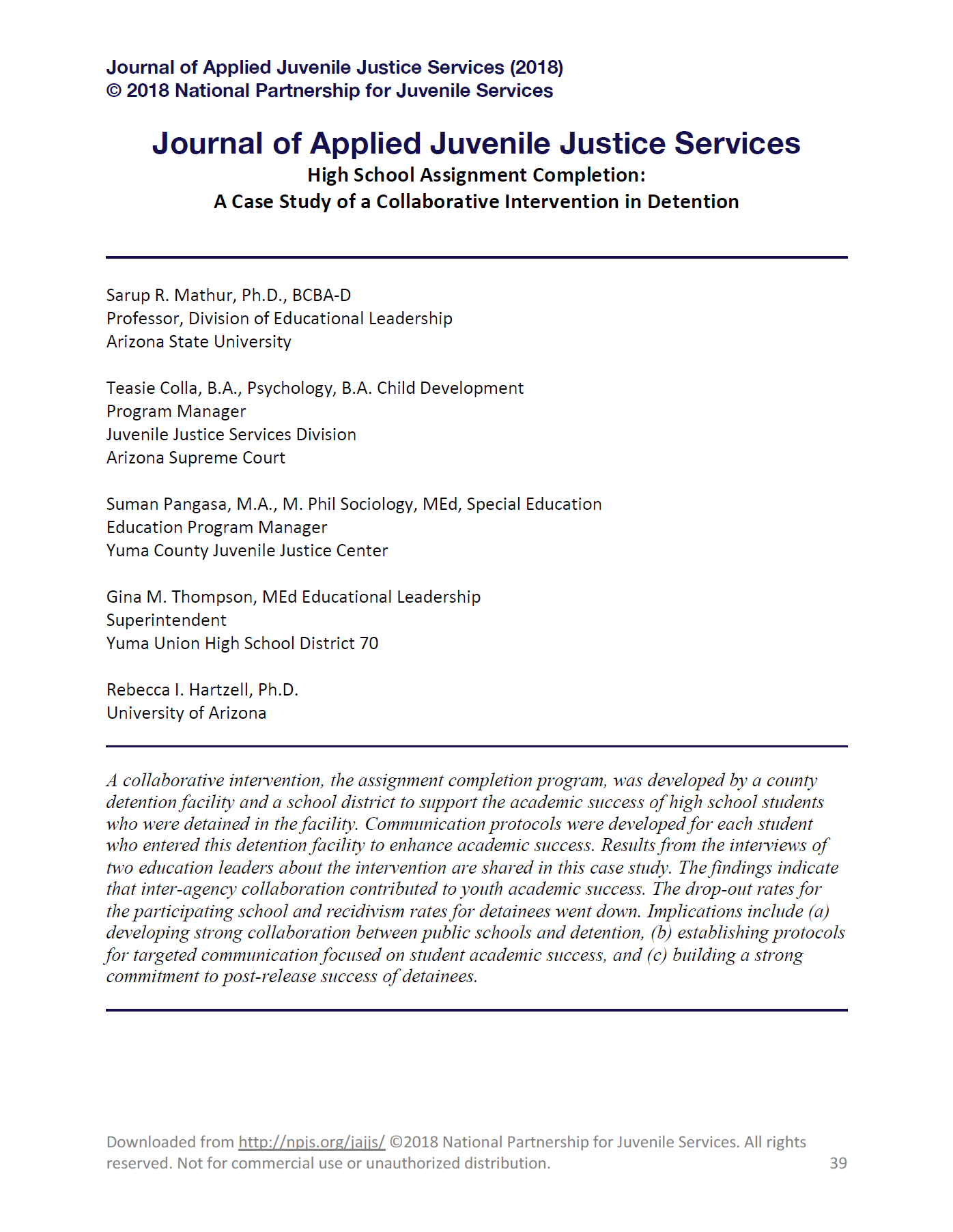
High School Assignment Completion: A Case Study of a Collaborative Intervention in Detention
DOI:
https://doi.org/10.52935/18.13120.01Abstract
A collaborative intervention, the assignment completion program, was developed by a county detention facility and a school district to support the academic success of high school students who were detained in the facility. Communication protocols were developed for each student who entered this detention facility to enhance academic success. Results from the interviews of two education leaders about the intervention are shared in this case study. The findings indicate that inter-agency collaboration contributed to youth academic success. The drop-out rates for the participating school and recidivism rates for detainees went down. Implications include (a) developing strong collaboration between public schools and detention, (b) establishing protocols for targeted communication focused on student academic success, and (c) building a strong commitment to post-release success of detainees.
References
Abbott, S., & Barnett, E. (2016). CYPM in Brief: Improving educational outcomes for crossover youth. Washington, DC: Center for Juvenile Justice Reform, Georgetown University McCourt School of Public Policy. Retrieved from http://cjjr.georgetown.edu/wpcontent/uploads/2015/08/CYPM-In-Brief-Educational-Outcomes.pdf.
Archer, D. N. (2010). Introduction: Challenging the school-to-prison pipeline. New York Law School Law Review, 54, 867-872.
Bullis, M., Yavanoff, P., & Havel, E. (2004). The importance of getting started right further examination of the facility-to-community transition of formerly incarcerated youth. The Journal of Special Education, 38, 2, 80 - 94.
Catalano, R. F., Oesterle, S., Fleming, C. B. & Hawkins, J. D. (2004). The importance of bonding to school for healthy development: Findings from the social development research group. Journal of School Health, 74, 252–261. doi:10.1111/j.1746-1561.2004.tb08281.x
Cumming, T., M., Marsh, J., & Higgins, K. (2017). School connectedness for students with disabilities: From theory to evidence-based practice. Routledge.
Darensbourg, A., Perez, E., & Blake, J. (2010). Overrepresentation of African American males in exclusionary discipline: The role of school-based mental health professionals in dismantling the school-to-prison pipeline. Journal of African American Males in Education, 7, 196–211.
Evanovich, L. L., & Scott, T. (2016). PBIS implementation: An administrator’s guide to presenting the logic and steps to faculty and staff. Beyond Behavior 25(1), 4-8.
Farn, A., & Adams, J. (2016). Education and interagency collaboration: A lifeline for justice involved youth. Washington, DC: Center for Juvenile Justice Reform, Georgetown University McCourt School of Public Policy. Available from http://cjjr.georgetown.edu/wpcontent/uploads/2016/08/Lifeline-for-Justice-Involved-Youth_August-2016.pdf.
Flower, A., McDaniel, S.C., & Jolivette, K. (2011). A literature review of research quality and effective practices in alternative education settings. Education and Treatment of Children, 34, 489-510.
Goerge, R. M., Smithgall, C., Seshadri, R., & Ballard, P. (2010). Illinois families and their use of multiple service systems. Chicago: Chapin Hall at the University of Chicago.
Gonsoulin, S., & Read, N.W. (2011). Improving educational outcomes for youth in the juvenile justice and child welfare systems through interagency communication and collaboration. Washington, DC: National Evaluation and Technical Assistance Center for Children and
Youth Who Are Neglected, Delinquent, or At Risk (NDTAC). Retrieved from http://www.neglected-delinquent.org/sites/default/files/docs/NDTAC_PracticeGuide_InteragencyCommunication_2011.pdf
Gonsoulin, S., Zablocki, M., & Leone, P. E. (2012). Safe schools staff development and the school-to-prison pipeline. Teacher Education and Special Education, 35, 309-319.
Gunter, P. L., Coutinho, M. J., & Cade, T. (2002). Classroom factors linked with academic gains among students with emotional and behavioral problems. Preventing School Failure, 46, 126–132.
Hirschfield, P. J. (2014). Effective and Promising Practices in Transitional Planning and School Reentry. Journal of Correctional Education, 65(2), 84-96.
Jolivette, K., McDaniel, S. C., Sprague, J. R., Swain-Bradway, J., & Ennis, R. P.(2012). Embedding the PBIS framework into the complex array of practices within AE settings: A decision-making approach. Assessment for Effective Intervention, 38, 15–29.
Jolivette, K., Patterson, D. P., Swoszowski, N. C., McDaniel, S. C., Kennedy, C., & Ennis, R. P. (2014). SWPBIS in a residential school for students with emotional and behavioral disorders: First years of implementation and maintenance follow-up focus groups. Residential Treatment of Children and Youth, 31, 63–79.
Kochhar-Bryant, C. A., & Lacey, R. (2005). Alternative education as a quality choice for youth: Preparing educators for effective programs. The National Conference of the Hamilton Fish Institute on School and Community Violence. Washington, DC: Fish Institute, George Washington University.
Lane, K. L. (2017). Building strong partnerships: Responsible inquiry to learn and grow together TECBD-CCBD keynote address. Education and Treatment of Children, 40, 597-618.
Lehr, C. A., Sinclair, M. F., & Christenson, S. L. (2004). Addressing student engagement and truancy prevention during the elementary years: A replication study of the Check & Connect model. Journal of Education for Students Placed At Risk, 9, 279–301.
Maddox S. J., & Prinz, R. J. (2003). School bonding in children and adolescents: Conceptualization, assessment, and associated variables. Clinical Child Family Psychology Review, 6, 31-49.
Mathur, S. R., & Griller Clark, H. (2014). Community engagement for reentry success of youth from juvenile justice: Challenges and opportunities. Education & Treatment of Children, 37(4), 713-734.
Mitchell, M. M., & Bradshaw, C. P. (2013). Examining classroom influences on student perceptions of school climate: The role of classroom management and exclusionary discipline strategies. Journal of School Psychology 51, 599–610
National Juvenile Detention Association (2018). Retrieved from http://npjs.org/detention/O'Neill, S. C., Strnadová, I., & Cumming, T. M. (2017). Systems challenges to community reentry for incarcerated youths: A review. Children and Youth Services Review, 79, 29-36.
Osher, D. (2002). Creating comprehensive and collaborative systems. Journal of Child and Family Studies, 11(1), 91–99.
Scott, T. M., & Cooper, J. (2013). Tertiary-Tier PBIS in alternative, residential and correctional School Settings: Considering intensity in the delivery of evidence-based practice. Education & Treatment of Children, 36(3), 101-119.
Shippen, M, E., Patterson, D., Green, K. L., & Smitherman, T. (2012). Community and school practices to reduce delinquent behavior: Intervening on the school-to-prison pipeline. Teacher Education and Special Education, 35, 296-308.
Skiba, R. J., & Losen, D. J. (Winter 2015-2016). From reaction to prevention: Turning the page on school discipline. American Educators.
https://www.aft.org/sites/default/files/ae_winter2015skiba_losen.pdf
Skiba, R. J., & Rausch, M. K. (2006). Zero tolerance, suspension, and expulsion: Questions of equity and effectiveness. In C. M. Evertson & C. S. Weinstein (Eds.), Handbook of classroom management: Research, practice, and contemporary issues (pp. 1063–1089).
Mahwah, NJ: Erlbaum Shufelt, J. L., Cocozza, J. J., & Skowyra, K. R. (2010). Successfully collaborating with the juvenile justice system: Benefits, challenges, and key strategies. Washington, DC: Technical Assistance Partnership for Child and Family Mental Health.
U.S. Department of Education Office for Civil Rights (2014). School Discipline, Restraint, & Seclusion Highlights Retrieved from https://ocrdata.ed.gov/downloads/crdc-schooldiscipline-snapshot.pdf
U.S. Department of Education Office for Civil Rights (2016). 2013-2014 Civil Rights Data Collection: A First Look, 4 (updated Oct. 28, 2016). Retrieved from www.ed.gov/ocr/docs/2013-14-first-look.pdf
U.S. Departments of Education and Justice. (2014). Guiding principles for providing high quality education in juvenile justice secure care settings. Retrieved from http://www2.ed.gov/policy/gen/guid/correctional-education/guiding-principles.pdf
Wilkinson-Lee, A. M., Zhang, Q., Nuno, V. L., & Wilhelm, M. S. (2011). Adolescent emotional distress: The role of family obligations and school connectedness. Journal of Youth and Adolescence, 40, 221–230. doi:10.1007/ s10964-009-9494-9
Zubrzycki, J. (2012). Young ex-offenders face rocky road back to school. Education Week, pp. 6-7.
Downloads
Published
Issue
Section
License
Copyright (c) 2018 Journal of Applied Juvenile Justice Services

This work is licensed under a Creative Commons Attribution-NonCommercial-NoDerivatives 4.0 International License.